
Original Japanese content
A developer’s explanation on 麻雀界web
Yukendo’s Morita explains the system, answers questions from the trial event, and discusses future plans in this authored article.
Read the article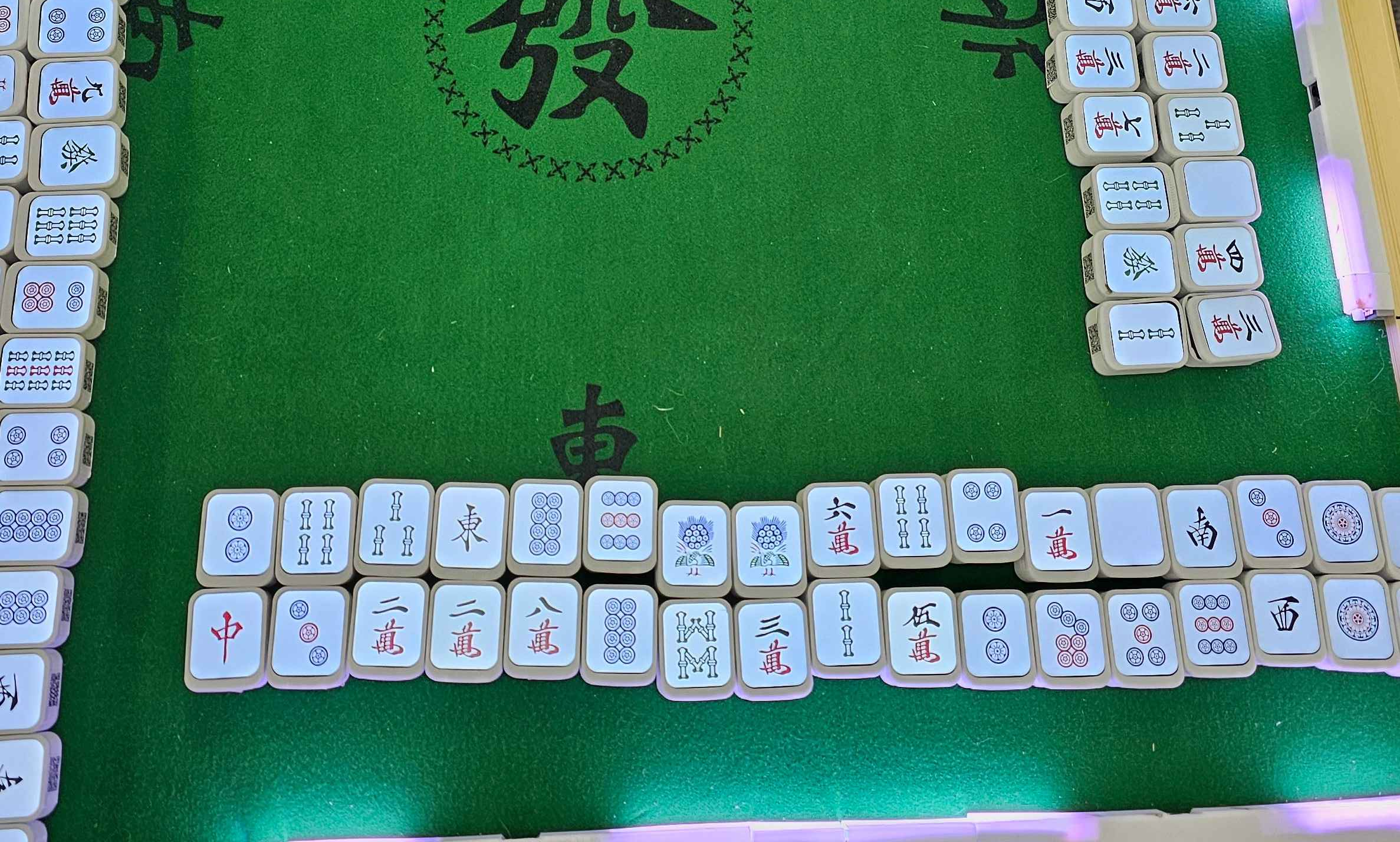
A new generation of electronic mahjong tiles
Retile turns the mahjong tiles themselves into electronic devices. Each of the 136 tiles contains a small computer (ESP32-S3), an IPS LCD for displaying the tile face, and a battery. A unique QR code on the side identifies the physical tile, independently of the face shown on its screen.
Each tile can change its face whenever it receives a new instruction. A tile showing One Character in one hand can become a White Dragon in the next. The name Retile reflects this idea: redefining a tile, again and again.
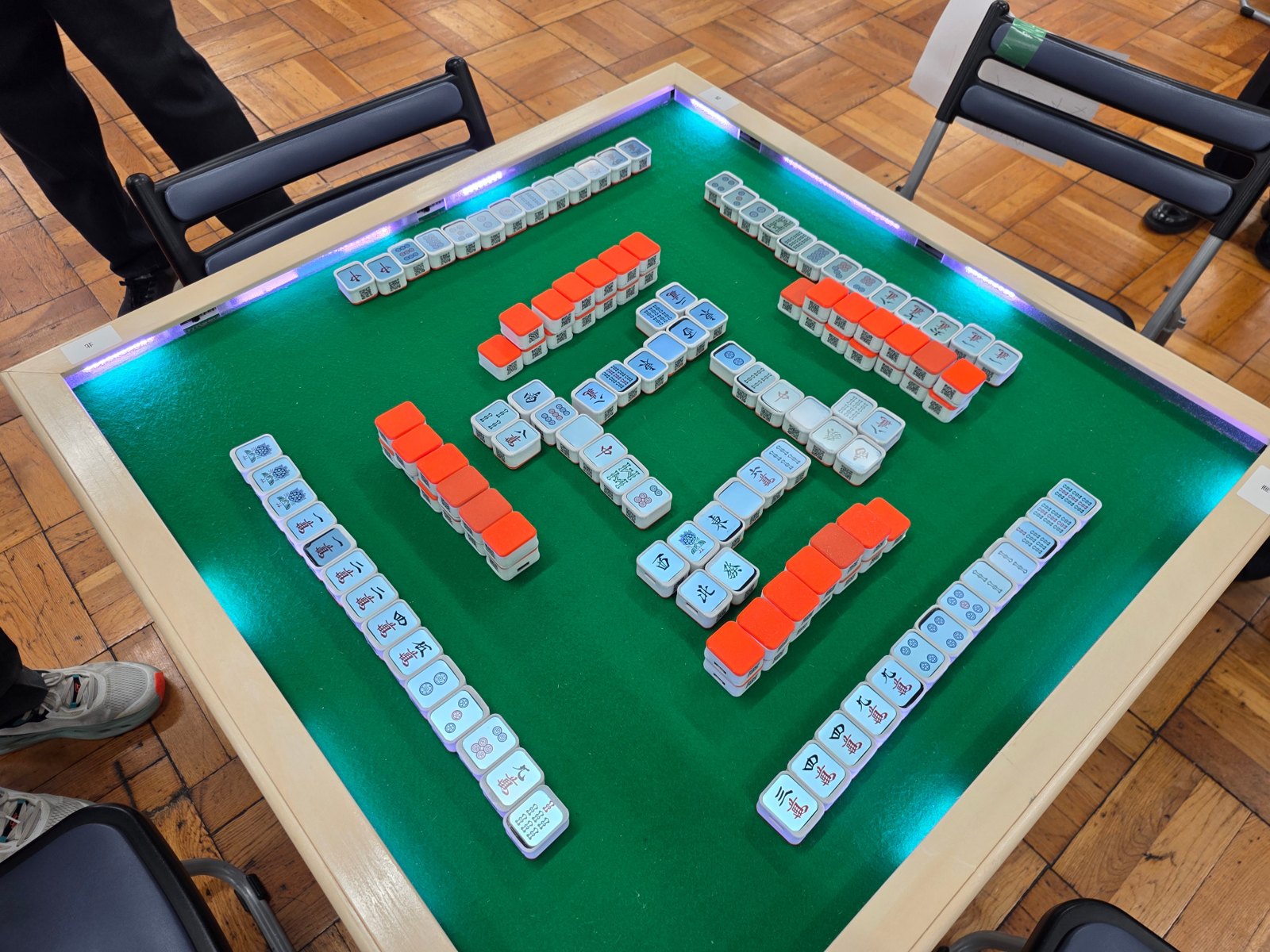
Mahjong results depend on both the tiles a player receives and the decisions they make. Duplicate mahjong gives multiple tables the same starting hands and the same tile-wall arrangement, making it easier to compare players' decisions and performance under comparable conditions.
Duplicate play is widely used in bridge. In mahjong, however, accurately preparing identical walls at multiple tables takes considerable manual effort. Retile helps address this by changing the faces of the 136 tiles after they have been arranged, rather than physically rearranging them to match the target hand.
ESP32-S3, IPS LCD and battery
Each tile displays the instructed face and wirelessly reports its battery voltage and the ID of the face it is currently displaying.
USB cameras and recognition server
The system photographs the 136 tiles and reads their side-mounted QR codes to identify each physical tile and its position.
Microcontrollers and LED lighting
These units provide light for the cameras and broadcast face-update instructions to the tiles.
Supplementary updates and manual checks are available for tiles that do not complete a broadcast update.
Compact computer
The server collects online status, battery voltage and reported face IDs from the 136 tiles so operators can check their state.
Web application
Operators can view system status, issue instructions and respond to exceptions.
A lightweight messaging system coordinates the equipment.
The operator selects the hand number on the dashboard and starts the preparation process.
The recognition system switches on the lighting and photographs the 136 arranged tiles from the sides of the table.
The system reads the QR codes to determine each physical tile's position. It proceeds only after exactly 136 tiles have been identified and validation has passed. If recognition is incomplete or an inconsistency is found, the process stops for an operator to check.
The system matches the physical arrangement to the target hand and generates an instruction specifying which face each tile should display.
The lighting and broadcast units send update instructions, and the tiles change their screens accordingly. Preparation time depends on recognition, wireless communication and conditions at the venue.
Each tile continues to report the ID of its displayed face. The dashboard compares these reports with the intended instructions to help operators spot incomplete updates or inconsistent states. This checks device-reported status; it does not optically verify the image on each screen.
Once the same preparation process is complete at multiple tables, play can begin with matching starting hands and tile walls.
If recognition is uncertain, the system stops. If the information needed to validate a step is missing, it does not proceed. Explicit checks and error reporting help prevent play from starting in an uncertain state.
Wireless broadcasts update the tiles in batches. Recovery options remain available for incomplete updates, and operators can inspect status and address exceptions.
The system checks image sharpness and adjusts exposure for changes in venue lighting, helping reduce their impact on recognition.
Key messages and operational logs help operators understand what happened and investigate problems afterward.
We are exploring ways to record play automatically, reducing the manual work involved in preparing mahjong game records and making them easier to analyze and use. This remains a research and development direction, rather than an available feature.
Original Japanese content
Yukendo’s Morita explains the system, answers questions from the trial event, and discusses future plans in this authored article.
Read the articleOriginal Japanese content
Watch a third-party video introducing Retile.
Watch the videoContact us to discuss adoption, joint development, media enquiries or event demonstrations.
Contact us